
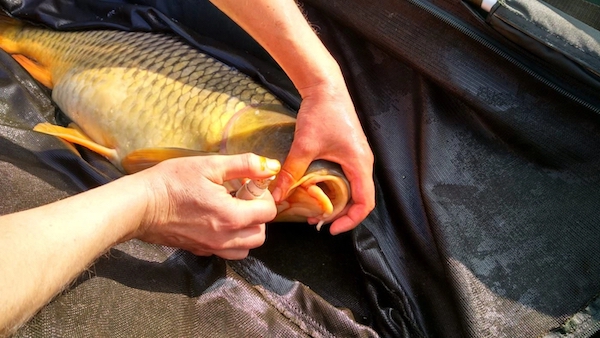
The Institute of Fisheries Management (IFM) is supporting the publication of important new research into the topical “carp care” products widely used by anglers and fishery managers across the UK.
The study, Scale of Concern: Efficacy of Commercially Available Topical Carp Care Formulations for Recreational Application in Carp, has been published open-access in Aquaculture Journal (2026) by a team at De Montfort University’s Leicester Institute of Pharmaceutical & Health Innovation, working with Lincolnshire Fish Health and IFM.
Ian Wellby, representing the Institute, provided advisory guidance to the research team – helping to shape the panel of products tested and the selection of the key carp pathogens used in the study, ensuring the science reflected real-world angling and fishery practice.
He said: “We are proud that IFM contributed to this work.
This is the first empirical study to test whether these products – many of which have been sold and used for more than 30 years – actually do what they claim. The results deserve the attention of every angler, fishery manager and fish keeper.”
The team tested 11 market-leading formulations against the four main bacterial and fungal pathogens affecting carp, alongside cellular toxicity and “wet adhesion” (how well a product stays put underwater). Three findings stood out.
Most products showed little or no activity against common carp pathogens and none met the full criteria the researchers set for an effective wound treatment.
Several were found to be toxic to carp skin cells even at very high dilutions – in some cases the equivalent of a single millilitre in five litres of water. And no product tested formed a lasting seal underwater; most washed off within 30 minutes.
The widely used propolis-based products were a particular focus. The study found they had no measurable antibacterial or antifungal effect against the carp pathogens tested, were toxic to carp cells, and did not adhere reliably underwater.
The researchers also reported that solvent-based formulations could permeabilise intact carp skin – potentially creating, rather than preventing, an entry point for infection.
Encouragingly, the study also identified naturally derived compounds that combined better antimicrobial performance with lower toxicity and even signs of supporting cell regeneration – pointing towards safer, more effective products in future.
Ian added: “IFM’s view is that this research is constructive, not alarmist. The authors are clear that anglers, fishery managers and fish keepers act in good faith and want the best for their fish. The issue is that, until now, there has simply been no published evidence to guide those choices, and no regulatory standard for products used on wild and open-water fish.
“We are not telling members to discard the products they currently use overnight. Rather, we welcome this study as a first step towards evidence-based fish care. It highlights the genuine value of scientific benchmarking, better product transparency, and – above all – closer dialogue between the trade and the research community. That is exactly the kind of partnership IFM exists to foster.” The Institute says it will continue to engage with researchers, manufacturers and members as this field develops and encourages anyone interested to read the full open-access paper HERE.