
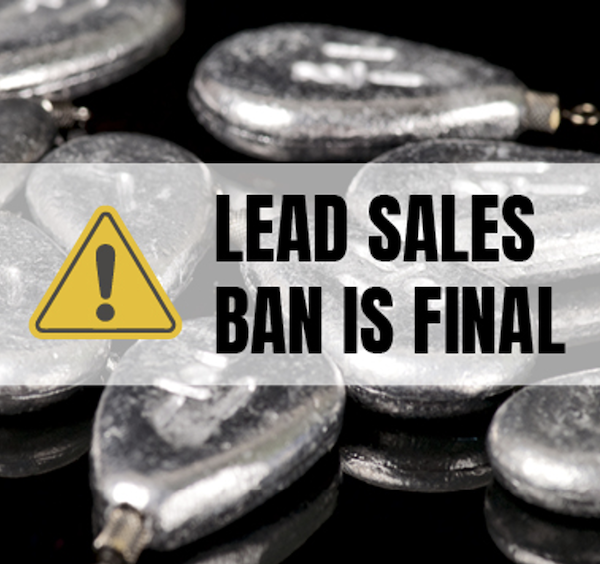
After years of debate and months of arguments by European fishing tackle organisations, restrictions on the sale (and not the use) of lead in tackle have been agreed across Europe.
As a result, there will be legislation banning the sale of certain lead fishing tackle in the recreational angling sector and this will be phased in stages over the next five years.
Despite strong efforts by industry body the European Fishing Tackle Trade Association (EFTTA) and consumer group the European Anglers Alliance (EAA), neither the European Parliament nor the Council objected to the proposal during the three-month scrutiny period.
EFTTA and EAA had called for the proposal to be reconsidered to ensure that the sales ban would be accompanied by a use ban. Those efforts have not succeeded.
The EU restrictions on lead in fishing tackle will therefore become law without an EU-wide use ban for recreational angling.
The regulations will be published in the Official Journal of the European Union, expected this autumn and will enter into force 20 days after publication.
The phased restrictions will see a sales ban on fishing wires and drop-in sinkers after six months, sinkers and lead weights weighing 50g or less will be banned from sale after three years and those weighing more than 50g and up to 140g after five years.
As a general rule, products covered by the restriction may contain less than one perc ent lead by weight but there will be exceptions for lures made from copper alloys containing less than three per cent lead and split shot weighing 0.06 g or less, if sold in spill-proof and child-resistant packaging.
Manufacturers, importers and distributors should start reviewing their product ranges and supply chains now and identify which products are concerned by the different phase-out periods. Products exceeding the applicable lead limits will have to be removed from the EU market by the relevant deadlines.
From six months after the regulation comes in, retailers selling sinkers and lures containing one per cent lead or more must provide prescribed warning information.
In physical shops, information must be displayed at the point of sale and in close proximity to the products concerned, online retailers must include the details in the distance sales offer. Furthermore, the information must be provided in the official language(s) of the country in which the product is sold and must warn customers the product contains lead, refer to the environmental and health risks and indicate the relevant EU phase-out dates.
No specific packaging labelling requirement has been established in the current regulations, at present.
Both EFTTA and EAA consider the final outcome disappointing. In a joint statement, they said: “The regulation is the result of many years of scientific assessment, consultation and legislative work aimed at creating an effective EU-wide solution to the health and environmental risks associated with lead in fishing tackle. The tackle trade has also been preparing for this transition for many years, investing in alternative materials and progressively moving towards lead-free solutions.
“Yet over the course of successive drafts, both the scope of the restriction and its implementation have been watered down. The originally proposed EU-wide sales and use restriction for recreational angling has become a sales-only restriction, while earlier provisions envisaging information on individual product packaging have resulted in a point-of-sale information requirement.
“Taken together, these changes raise questions about how effective the Regulation will be in achieving its intended environmental and health objectives. Lead tackle already owned by anglers can continue to be used, products prohibited from sale may potentially enter through illegal imports, and the warning information required at the point of sale does not necessarily remain with the product after purchase.
“EFTTA and EAA had argued for a clear and consistent EU-wide approach: a sales and use restriction applying equally across all member states. This would also have reduced the risk of different national rules developing across Europe.”
While he EU decision is now final. However, the Regulation does not harmonise the recreational use of lead fishing tackle across Europe. Member States remain free to introduce or maintain their own restrictions on use. So there is still hope that some will combine the sales ban with restrictions on use. At the same time, different national approaches could result in further fragmentation of the European market.